Humanoid Robots Enter Power Grid Operations: From High-Risk Inspection to Unattended Energy Infrastructure
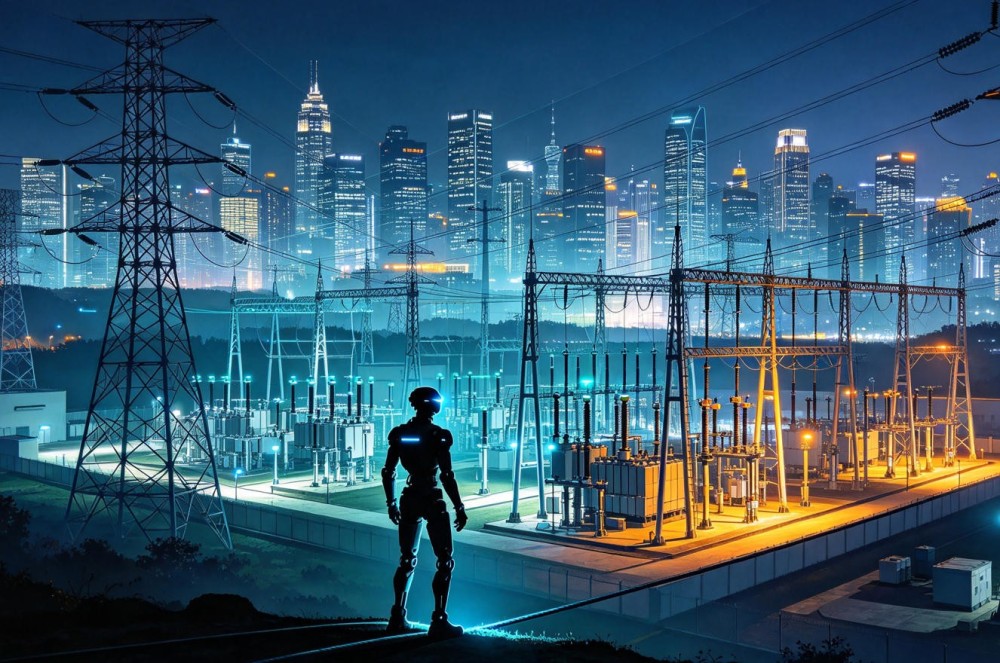
As The 3rd Hangzhou International Humanoid Robot and Robot Technology Exhibition 2027 (HRTE 2027), taking place May 27–29, 2027, at the Hangzhou Grand Convention and Exhibition Center in Zhejiang Province, approaches in Hangzhou, one scenario that is easy to overlook yet intensely necessary is being reconsidered: can the power and energy sites scattered across cities and countryside be entrusted to humanoid robots as caregivers? Substations, distribution rooms, transmission corridors, and renewable sites such as wind farms, photovoltaic stations, and storage facilities are the energy hearts of modern society, yet they have long relied on manual inspection in high-risk, high-frequency settings. As general-purpose robot bodies gradually acquire stable walking, dexterous manipulation, and autonomous perception, energy operations—this "silent necessity"—are becoming a proving ground for humanoids to move from exhibition halls into the real world.
Why Power Grid Operations Are a High-Stakes, High-Frequency Need
Inspection in the power industry has never been easy work. Substations are crowded with live equipment, distribution rooms are cramped and dense, transmission lines cross mountains and rivers, and wind, solar, and storage sites are often located in remote or climatically extreme regions. According to publicly available information, the power sector has long been classified as a key focus area for special-operation safety, where live environments, work at height, and confined spaces each pose continuous risks to frontline personnel. Compounding this, many grids worldwide are aging while electricity demand keeps climbing, and a generation of seasoned inspectors is approaching retirement faster than newcomers are trained. The result is a structural shortage that technology, not headcount alone, must help close.
The harder pressure comes from frequency. Equipment status requires periodic patrol—meter readings, indicator lights, joint temperatures, partial-discharge acoustics, ambient humidity, fire protection, and access control—work that repeats endlessly, is tedious, and cannot tolerate error. At night, on holidays, or in extreme weather, the gap in staffing for keep watch and emergency response becomes even more pronounced. Under the traditional model, inspection quality depends heavily on the experience of veteran workers, which is difficult to standardize, quantify, and fully transmit amid personnel turnover.
This is precisely why humanoid robots are carrying high expectations: they need not replace the entire power system, but can first take on the "dangerous, repetitive, late-night, and remote" tasks—freeing people from hazard and monotony.
Three Roles on Site: From Seeing to Checking to Acting
If a humanoid robot is deployed in a substation or a storage station, what it can do roughly falls into three categories.
The first is "seeing"—equipment appearance and condition inspection. Using visible-light cameras, infrared thermal imagers, and microphone arrays mounted on its body, the robot can follow planned routes to verify meter readings, recognize indicator and disconnector positions, capture abnormal joint heating, and collect acoustic signatures of partial discharge. Compared with fixed monitoring, it can climb stairs, pass through narrow aisles, and reach corners that humans easily miss.
The second is "checking"—comprehensive environment and safety verification. Whether a distribution room leaks, harbors intruding objects, keeps fire equipment in place, maintains normal access control, or exceeds harmful-gas thresholds often determines the boundary of an accident. A humanoid body that patrols autonomously and reports autonomously is like a tireless night watchman for the site.
The third is "acting"—lightweight intervention and emergency linkage. Upon detecting an anomaly, the robot need not merely "alert." Within preset authority, it can clear foreign objects, assist with emergency switching, dynamically re-plan inspection paths, and stream live images and data back to the dispatch center through its communication interface to trigger coordinated response. Moving from "seeing the problem" to "stabilizing it first" is the unique value that distinguishes humanoids from fixed cameras and wheeled inspectors.
Zhejiang and the Yangtze River Delta: A Natural Proving Ground for the New Power System
Why does this topic deserve focused discussion in Hangzhou? Because Zhejiang itself is both a "pressure cooker" and a "showcase" of energy transition. As a major electricity-consuming province, Zhejiang has in recent years vigorously built a new power system, with distributed photovoltaics, offshore wind, and user-side storage expanding rapidly. The grid form is shifting from "source following load" to "source-grid-load-storage" coordination, and the complexity and density of operation objects rise in tandem.
Hangzhou's digital-economy foundation provides a natural soil for "robot plus power Internet of Things": power equipment is broadly networked, dispatch data is observable and controllable, and the vision and edge-computing supply chains are mature. Coupled with the Yangtze River Delta's manufacturing accumulation in robot bodies, reducers, servos, machine vision, and sensors, a closed loop of "sites propose needs, local supply chains respond quickly" is taking shape. For humanoid robot companies, Zhejiang and the Delta are both a technology validation field and a nearby industrial hinterland for supporting. This is exactly why HRTE 2027 places its stage in Hangzhou and focuses on the full humanoid robot industry chain—bringing real scenarios and local supply chains onto the same map.
Three Hurdles: Protection, Navigation, and Accountability
The prospect is attractive, but three hard hurdles remain before deployment.
The first is protection level and environmental adaptation. A substation is a strong electromagnetic environment; outdoor sites must withstand high temperature, severe cold, rain, snow, and dust; some scenarios involve explosion-proof requirements. For a humanoid robot to truly enter the field, it must meet industry thresholds in insulation, electromagnetic compatibility, and ingress protection—not merely "walk in demos but fail in practice."
The second is localization and navigation in complex environments. With dense equipment, intense metallic reflection, narrow aisles, and inconsistent floor markings, such scenes are a severe test for simultaneous localization and mapping (SLAM). The robot must both recognize the route and safely sidestep, avoid obstacles, and climb steps among equipment; even slight localization drift can create collision risk.
The third is reliability and accountability. What if inspection misses or false-alarms occur? Where is the permission boundary for anomaly handling? When the robot's judgment conflicts with dispatch instructions, which takes precedence? The answers determine how far it can be trusted. Energy is critical infrastructure tied to public livelihood, with a far lower error tolerance than a factory floor, so the chain of responsibility must be clearly written. Industry standards and certification—covering functional safety, cybersecurity, and remote-operation protocols—will therefore be as decisive as the hardware itself, because grid operators cannot onboard unproven bodies into regulated environments.
The Workforce Question: Augmentation, Not Erasure
A reasonable fear is that robots will displace power inspectors. The more likely trajectory is augmentation. Humanoids absorb the most hazardous, repetitive, and nocturnal tasks, while experienced engineers move up the value chain toward judgment, exception handling, and system optimization. The "night watchman" does not erase the "engineer"; it expands what a small team can safely manage. In a sector where skilled labor is already tight, that trade is less about replacement and more about covering gaps that human staffing alone cannot fill.
From Pilot to Scale: RaaS and the "Less-Manned" Pace
The pragmatic pace is not an overnight "unmanned" leap but a gradual "less-manned" progression. The easiest tasks to land first are night keep watch, routine inspection at remote sites, and high-risk links such as live or elevated work—places where labor cost is high and risk is great, and where the marginal benefit of robot substitution is clearest.
In business model, Robotics-as-a-Service (RaaS) lowers the utility's one-time procurement threshold: deploy by lease plus operations and maintenance, paying by inspection mileage or number of sites, with the supplier responsible for upgrades and maintenance. This also lets grid enterprises experiment and fail small, without betting on a single technical route. Early demonstrations are likely to cluster around green, low-risk sites—such as storage stations and distribution rooms—where value is obvious and the blast radius is small, before any move toward transmission-level or live-line contexts.
More important is collaboration, not substitution. Existing wheeled inspectors, drones, and SCADA systems each have strengths; the humanoid's addition fills the gap of "can climb stairs, open doors, and perform lightweight operations." Combined with simulation training and digital-twin rehearsal, robots can first run paths and handling procedures in a virtual site, then be pushed to the real one—significantly shortening deployment cycles and reducing on-site risk. And these hard problems are precisely the topics that HRTE 2027's body makers and system integrators are most willing to discuss with real scenarios.
Conclusion
Energy is the underlying infrastructure of civilization, and operations are its never-resting "heartbeat" that cannot stop for a moment. Humanoid robots entering power sites does not mean stations become empty overnight, but rather that people step away from hazardous, repetitive, and nocturnal posts to do work that demands more judgment and decision-making. As body reliability, environmental adaptability, and accountability frameworks mature, this track is expected to become an "invisible main force" in the scaled deployment of robots.
HRTE 2027 will be an important window for observing this progress—by then, from body manufacturers to sensors, machine vision, and system integrators, more answers close to real sites may emerge. For an industry that prizes reliability above all, this steady convergence of scenario, supply chain, and standards is exactly what turns a promising demo into dependable infrastructure.

Approved by
Ministry of Commerce of the People's Republic of China
Hosted by
Zhejiang Robot Industry Association
Zhejiang University Robotics Institute
Golden Conference & Exhibition Group
Organized by
Hangzhou Wisdom Source Exhibition Co., Ltd.
Hangzhou Sequoia Exhibition Co., Ltd.
Supported by
Ningbo Magnetic Materials Association
Contact Us